

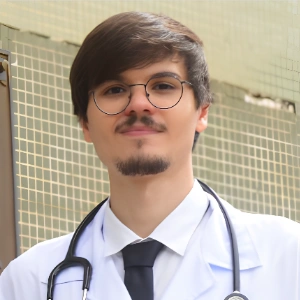
Speaker
Lucas Campos
- Pontifical Catholic University of Sao Paulo
- Brazil
Presentation
Analysis of sulpiride release from a modified gel for schizophrenia
- April 19-20, 2027
- Paris, France
Biography
Lucas Campos is a medical doctor based in Sorocaba, São Paulo, Brazil, with interests in Psychiatry and affiliated to the Pontifical Catholic University of São Paulo.
Abstract
Background: Sulpiride, a dopamine D2/D3/D4 receptor antagonist, is predominantly administered orally and has a relatively short half-life. This study aimed to develop and evaluate a polymeric membrane containing sulpiride for prolonged drug release, using a combination of Polyvinyl Alcohol (PVA) and natural rubber latex.
Methods and Materials: Four sulpiride-loaded polymeric membranes were prepared using different Latex/PVA ratios: 50/50, 75/25, 80/20, and 90/10. Each formulation contained 500 mg of sulpiride. The membranes were produced by solvent casting and subsequently subjected to freezing, thawing, and drying cycles. In vitro drug release was evaluated using phosphate-buffered saline at room temperature for 240 hours. Sulpiride concentrations were determined by UV spectrophotometry at 242 nm. Release kinetics were analysed using the Korsmeyer–Peppas, Higuchi, First-Order, and Zero-Order models.
Results: All formulations exhibited an initial burst release during the first hours, followed by a slower and more stable release phase. After 5 hours, cumulative sulpiride release ranged from 8.7% to 10.9%, while after 48 hours it ranged from 12.5% to 14.9%. The 90/10 formulation showed a slight increase in release during the later phase, reaching approximately 15% at 192 hours. During the initial release phase, the Higuchi and Korsmeyer–Peppas models showed the best fits (R² approximately 0.99), with Korsmeyer–Peppas n values ranging from 0.50 to 0.62, suggesting anomalous transport involving diffusion and polymer matrix relaxation. In the later phase, First-Order and Zero-Order models showed satisfactory fits.
Conclusion: The combination of natural rubber latex and PVA demonstrated potential as a polymeric matrix for prolonged in vitro sulpiride release. The results suggest that drug release is governed by the combined effects of diffusion, matrix hydration, and structural changes. Further studies are required to optimize the formulations and evaluate their physicochemical properties, skin permeation, and biological applicability.
