

Largest Real-World Study Highlights Deep TMS as a Promising Treatment for PTSD and Depression
Post-Traumatic Stress Disorder (PTSD) and Major Depressive Disorder (MDD) frequently occur together, creating a significant challenge for both patients and healthcare professionals. Individuals living with these coexisting conditions often experience more severe symptoms, greater functional impairment, and a lower quality of life than those diagnosed with either disorder alone. Although psychotherapy and medications remain the cornerstone of treatment, many patients continue to experience persistent symptoms, emphasizing the need for more effective therapeutic approaches.
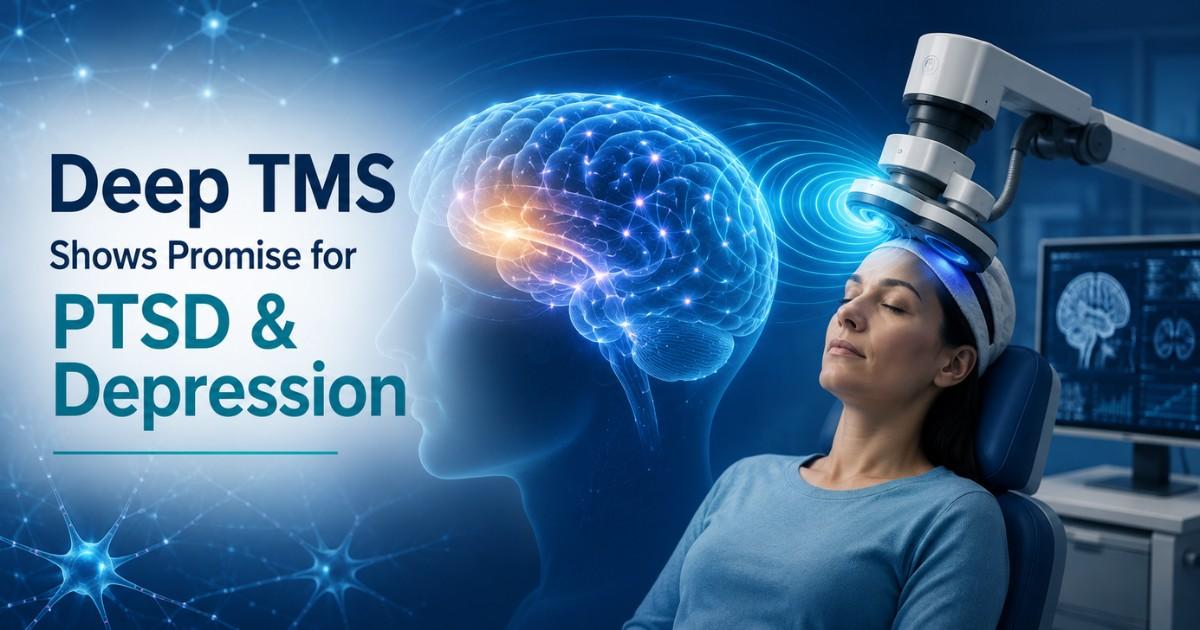
Recent findings presented by researchers and reported in Psychiatric Times offer encouraging evidence that Deep Transcranial Magnetic Stimulation (Deep TMS) may provide meaningful clinical benefits for patients living with both PTSD and depression. The study represents the largest real-world analysis of Deep TMS conducted in this patient population to date, providing valuable insights into how this non-invasive brain stimulation therapy performs in routine clinical practice rather than under tightly controlled clinical trial conditions.
The retrospective analysis included 462 patients diagnosed with both PTSD and MDD who received treatment across 11 clinical centers. Each participant completed at least 20 sessions of Deep TMS using specialized stimulation coils designed to target brain regions associated with mood regulation and emotional processing. Researchers evaluated treatment effectiveness by comparing symptom severity before and after therapy using well-established clinical assessment tools: the PTSD Checklist for DSM-5 (PCL-5) and the Patient Health Questionnaire-9 (PHQ-9).
The results were highly encouraging. More than 83% of patients experienced a clinically meaningful improvement in PTSD symptoms, defined as at least a 50% reduction in symptom severity. On average, PTSD symptom scores declined by 52% following treatment. Improvements were also observed in depressive symptoms, with approximately 67% of patients achieving a significant treatment response and more than 27% reaching remission. Overall, depression scores decreased by an average of 50%, suggesting that Deep TMS may positively affect both conditions simultaneously. These findings highlight the potential of targeted brain stimulation to address complex psychiatric disorders that often prove difficult to treat using conventional therapies alone.
PTSD and depression frequently reinforce one another, making recovery more complicated. Previous epidemiological studies indicate that nearly half of individuals diagnosed with PTSD also experience major depressive disorder during their lifetime. This combination is associated with increased suicide risk, chronic illness, greater disability, and reduced response to standard treatments. Because of this overlap, identifying therapies capable of improving both disorders at the same time is an important priority in mental health research.
Deep TMS is a non-invasive neuromodulation technique that uses magnetic pulses to stimulate deeper brain networks involved in emotional regulation. Unlike medications, which influence brain chemistry throughout the body, Deep TMS directly targets specific neural circuits believed to contribute to psychiatric symptoms. The procedure does not require surgery or anesthesia, and patients remain awake during treatment sessions, making it an attractive option for individuals who have not responded adequately to conventional therapies.
Despite these promising findings, researchers caution that the results should be interpreted carefully. The study was retrospective and reflects real-world clinical experience rather than a randomized controlled trial. Furthermore, Deep TMS has not yet received FDA clearance specifically for the treatment of PTSD or the combined diagnosis of PTSD and MDD, and the current findings remain preliminary while awaiting peer review. Additional prospective clinical trials will be necessary to confirm long-term safety, effectiveness, and optimal treatment protocols.
Nevertheless, this large-scale analysis represents an important step forward in the evolving field of psychiatric neuromodulation. As researchers continue to explore innovative, non-invasive therapies, Deep TMS may emerge as a valuable addition to the treatment landscape for individuals living with complex mental health conditions. Continued scientific investigation will help determine how this technology can best complement existing psychological and pharmacological interventions, ultimately expanding treatment options for patients who continue to struggle with PTSD and depression.

Quick Links
Explore More
Past Conferences
Past Webinars
General Enquiry
Finance Enquiry
Contact Number
- (+1) 689 303 3812