

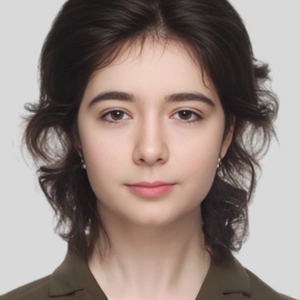
Renata Mamina
University of Potsdam, GermanyPresentation Title:
Comparison of patterns of neuronal activity in VWFA depending on stimuli lexicality during silent reading task in healthy adults: A MEG study
Abstract
The current investigation examines the extent to which the lexicality of visual stimuli affects neuronal activation in the Ventral Occipitotemporal Cortex (VOTC), specifically within the Visual Word Form Area (VWFA), during silent reading. Magnetoencephalography (MEG) with millisecond temporal precision was used to examine cortical activation in response to high-frequency Russian words, low-frequency words, and pseudowords in 30 healthy adults. Individualized source localization and linear mixed-effects modeling revealed significant stimulus-dependent modulation along the superior–inferior (z) axis (p = 0.0098), with both high-frequency words and pseudowords evoking stronger responses than low-frequency words. However, no anterior–posterior dissociation between VWFA-1 and VWFA-2 was observed, contradicting the hypothesis of a rigid functional gradient for lexicality within the VOTC.
The data suggest non-linear tuning to lexical properties and some degree of individual variability, which implies functional specialization within the VWFA might be more continuous than categorical. This model also counters a common understanding of orthographic–lexical (e.g., VWFA) segregation, highlighting the value of person-specific analyses in neurocognitive studies of reading. As the first MEG study to investigate lexical processing in Russian, this study expands the cross-linguistic framework for visual word recognition and further demonstrates the methodological foothold for making use of MEG to complement MRI (e.g., diffusion and structural) for reading-related cortical organization models.
Biography
Renata Mamina is a graduate student in the International Experimental and Clinical Linguistics (IECL) Master’s program at the University of Potsdam. She completed her Bachelor’s degree in Fundamental and Computational Linguistics at the Higher School of Economics (HSE University, Moscow), specializing in psycho- and neurolinguistics. Her research focuses on the neural and cognitive mechanisms underlying language, with a particular emphasis on lexical processing and reading. At the HSE Center for Language and Brain, she conducted an MEG study on neuronal activity in the Visual Word Form Area (VWFA) during silent reading. Renata has experience in neuroimaging data analysis, multimodal annotation, and statistical modeling using R, Python, and MATLAB. Her work integrates linguistic theory and experimental neuroscience to advance understanding of how the brain processes written language.

Organization Location
1309 Coffeen Avenue, STE 1200, Sheridan, Wyoming 82801, USA
Mail us at
Drop us an email for Program enquiry
neuralscience@scientexconferences.com
Registration Enquiry
finance@scientexconferences.com
General Queries
contact@scientexconferences.com
neuralscience@scientexconference.org
Our Social Presence
Call us at
USA : (+1) 689 303 3812